For ten years, a Sunset March every day
For ten years, a Sunset March every day
It is almost 9:30 p.m. when a group of young people gather at De Oversteek, a bridge in Nijmegen. Just a little longer. Then the sun will set and the lanterns will light up. The Sunset March will begin.
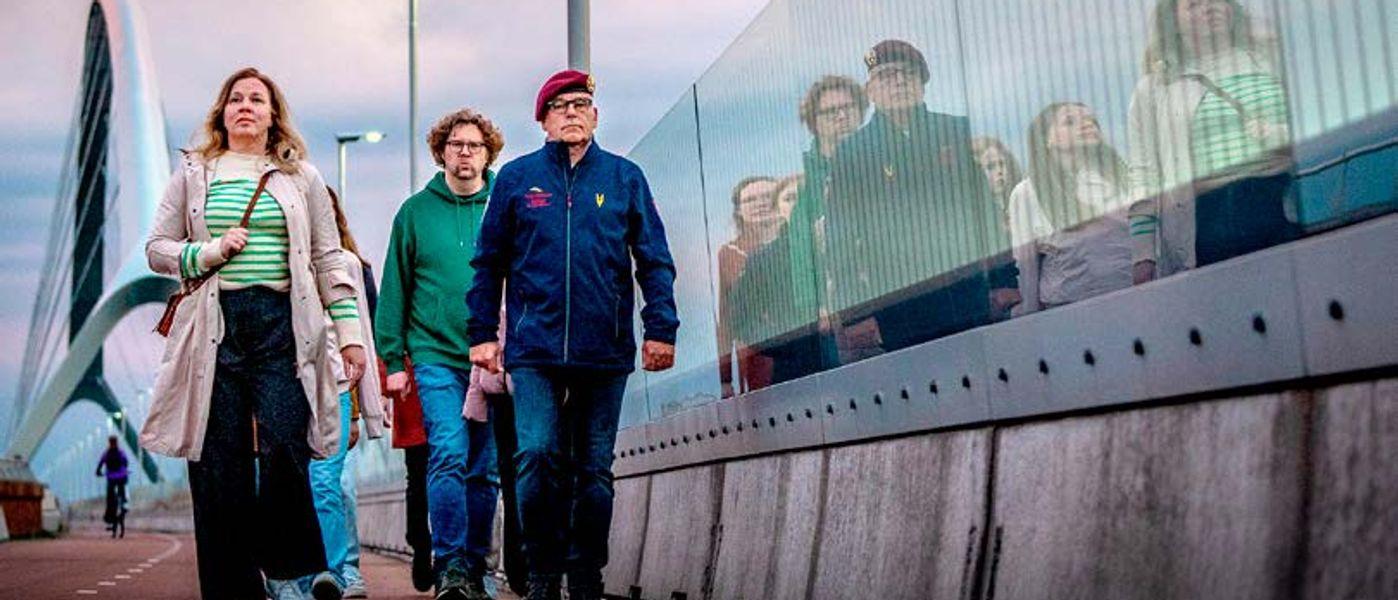
This spring, the boys and girls of the youth editorial team of the neighborhood magazine Lentse Lucht walked the Sunset March together with veteran Peter Grotens. Peter tells them what happened here. Then they walk to the other side, at the pace of the light poles that come on one by one. On the other side, they pause at the monument to the fallen soldiers. For some of the young people, the historical story is new. The history of the soldiers who crossed the river here in boats during Operation Market Garden makes an impression.
The Sunset March takes place 365 days a year. Every day of the year, a veteran is present and interested parties can join in. For the young people of Lentse Lucht, the history of Nijmegen and the crossing of the Waal River is practically in their backyard. That is why they wanted to participate and report on it.
Peter Grotens believes it is important to share the story, but in the meantime he himself is also hearing all kinds of things about the war that he did not know before. "For example, we sometimes have relatives of soldiers who died during Operation Market Garden or even during the Crossing. These are impressive stories."
The Sunset March has now been held every day for almost ten years. In winter, it takes place at the end of the afternoon, and in summer, late in the evening. It always takes place at sunset, rain or shine. Veterans can sign up, and a club of 31 veterans serves as a kind of backup, so that there is always someone to walk. "In total, more than 920 veterans have walked the Sunset March for the first time." Grotens himself also walks regularly. "Sometimes not for three weeks, sometimes three times a week. I also join in when there are foreign visitors or dignitaries. You want to convey the history properly, after all."
For more information: www.sunsetmarch.nl

The young people and their supervisors in conversation with march leader Peter Grotens.
Photo: Eveline van Elk
BOAZ. 12 years old
'Dying far from home'
I think it's really special that the Sunset March is held every day. It's important to show respect to the people who had to row in small boats. There weren't nearly enough paddles for everyone, so a lot of soldiers had to use their rifles to paddle. They had to work really hard to get to the other side, and all for freedom. Fighting in a war seems very scary to me. I hope I never have to do that. The soldiers were also very far from home. Not even in their own country. Dying far from home to help people you don't even know. I think it's good that these people are commemorated. They were real heroes."
Peter Grotens, veteran and chairman of Sunset March
'This is still happening'
People are often surprised when they hear what happened here in September 1944. Not everyone knows the history. And that surprises me. I enjoy telling young and old alike about the big picture. This is what happened then. And what is still happening now.
NOA and GUUSJE, both 15 years old
'They took a big risk for us'
It was interesting to walk along with the Sunset March because you could hear the story about the crossing. We didn't know everything, for example that the rowboats they used to cross over were very basic and simple. This meant that the soldiers had little protection against the Germans and were taking a huge risk on their journey. The fact that the story was told by a veteran made it even more special for us, because he actually fought for the Netherlands. We learned that even veterans from other countries take part in the Sunset March.”
ROSALIE, 12 years old
'Each lamp represents a soldier who was shot dead'
“Each lamp represents a soldier who was shot dead by the Germans during the war, while crossing the Waal River in small boats. At sunset, the first lamp was lit and we walked silently in pairs across the bridge. The walk ended on the Lent side of the Waal, at a monument where people often lay flowers to commemorate the soldiers.”
What is the Sunset March?
Since October 19, 2014, the Sunset March has been a daily tribute to the Allied soldiers who fought for the freedom of the Netherlands. This takes place at the De Oversteek city bridge in Nijmegen. It was approximately at this spot that American soldiers crossed the Waal River during Operation Market Garden on September 20, 1944. During this so-called 'Waal crossing', 48 Allied soldiers were killed.
The lighting of De Oversteek is unique. There are 48 pairs of light poles on the bridge. Around sunset, these light poles are lit up one by one, pair by pair, at the pace of a slow march. Every evening, when the first pair of light poles lights up, a veteran walks along with the Sunset March at the pace at which the lights come on.
With this initiative, the veterans not only want to commemorate the sacrifice made by American soldiers far from home for the freedom of the Netherlands. Above all, they want to build a visible bridge to all veterans who have contributed, and continue to contribute, to peace and freedom in missions around the world. Veterans of various nationalities have already walked the Sunset March, often together with interested parties.
Special edition: the Sunset March XXL
On Saturday, September 21, there will be a special edition of the Sunset March. All participants will receive a glow stick that evening, creating one large ribbon of lights across the bridge. Everyone is invited to join the march.

Image from the previous edition of the special Sunset March, in September 2019, marking 75 years of freedom.